
Cognitive Dinosaurs
Hi friend,
Let me ask you a question.
Is this a terrifying dinosaur?
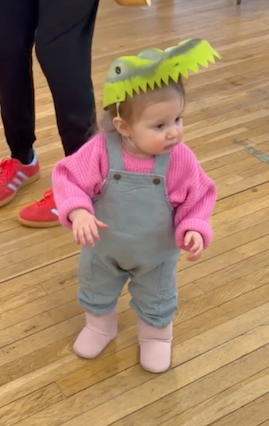
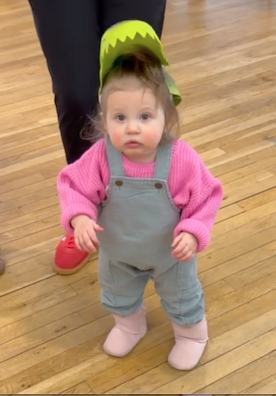
Or just my sweet Poppy dressed up as one?
Okay—this one’s probably not actually a close call.
But watching my almost-one-year-old (8 days and counting!) toddle around in a dinosaur mask got me thinking about how our minds often do something similar: dressing the things we experience up in unnecessarily scary costumes.
Our brains are wired to keep us safe. That’s their job. And they’re very good at it—sometimes too good.
So when we encounter something neutral or mildly uncomfortable, our brains often rush in to fill in the blanks.
A delayed email becomes: I must have done something wrong.
Constructive feedback becomes: I’m going to get fired.
An unfinished to-do list becomes: I’m dropping the ball everywhere.
None of these thoughts are malicious.
They’re a reflection of our brains’ efforts to protect us.
But they’re also often wildly inaccurate—not to mention unhelpful.
Psychologists call these patterns “thinking traps” or “cognitive distortions”—automatic ways our minds misinterpret reality in a counterproductive manner.
Some of the most common thinking traps I see (and, at times, still succumb to myself) include:
Catastrophizing: Assuming the only plausible outcome is the worst outcome imaginable
Mind-reading: Assuming we know what others are thinking—and that it’s something bad about us
Personalizing: Assuming a negative event is a direct reaction to us
All-or-nothing thinking: Seeing things in extremes—total success or total failure, perfect or terrible, “I nailed it” or “I blew it”
Overgeneralizing: Taking one moment, mistake, or off day and turning it into a sweeping conclusion (“I always mess this up”)
“Should” statements: Rigid rules we use to judge ourselves (“I should be further along,” “I shouldn’t feel this way,” “I should be able to do it all”)
Emotional reasoning: Assuming that because something feels true, it must be true (“I feel anxious, so I must not be ready/good enough”)
Thinking traps are fast, automatic, and incredibly convincing.
They don’t feel like guesses—they feel like facts.
Which is why they’re so powerful.
But like that dinosaur mask, they’re often just benign circumstances dressed up in a scary costume.
That’s why I’ve always loved the acronym:
FEAR = False Evidence Appearing Real
The problem isn’t that we experience fearful thoughts. That’s completely natural.
The real issue is that we tend to treat our anxious brains like a reliable narrator.
The work (and the relief) comes from pausing long enough to ask ourselves a few grounding questions:
What story is my brain telling me right now?
How plausible is that story, really?
Would it feel as convincing if it were coming from someone else?
And even if the story might be true, is dwelling on it actually serving me?
These questions don’t make fear disappear.
But they do help us loosen its grip and respond with intention instead of reflex.
With curiosity instead of panic.
With compassion instead of criticism.
And with constructiveness instead of helplessness.
And more often than not, when we slow down long enough to really look, we realize that what we’re reacting to isn’t an actual threat—it’s discomfort, uncertainty, or perhaps even an opportunity for growth.
So yes—sometimes, fear is wisdom.
But sometimes, what looks like a terrifying dinosaur is really just a reminder that our brains are very creative storytellers.
And we don’t have to believe every story they tell us.
So today, friend, I encourage you to ask yourself:
What scary story have you been accepting as truth?
And what would it be like to replace that story with a more empowering narrative?
As always, don’t hesitate to reach out if there’s any way I can support you in countering your own cognitive dinosaurs.
In the meanwhile, know that I am rooting for you. 🦖💕
With love,
Jordana